
Goods and Services Tax, commonly known as GST, has been one of the most significant tax reforms in India. Introduced to replace multiple indirect taxes, GST aimed to simplify taxation, improve compliance, and create a unified national market. While the framework is now familiar, many businesses still struggle with day-to-day compliance and practical interpretation.
This blog explains GST in simple terms, with a focus on what businesses actually need to know.
What is GST?
GST is a destination-based indirect tax levied on the supply of goods and services. It is collected at each stage of value addition, but the tax burden ultimately falls on the final consumer. Businesses act as tax collectors on behalf of the government.
GST has replaced taxes such as VAT, Service Tax, Excise Duty, and several cesses, bringing them under a single system.
Types of GST in India
GST is divided into four main components:
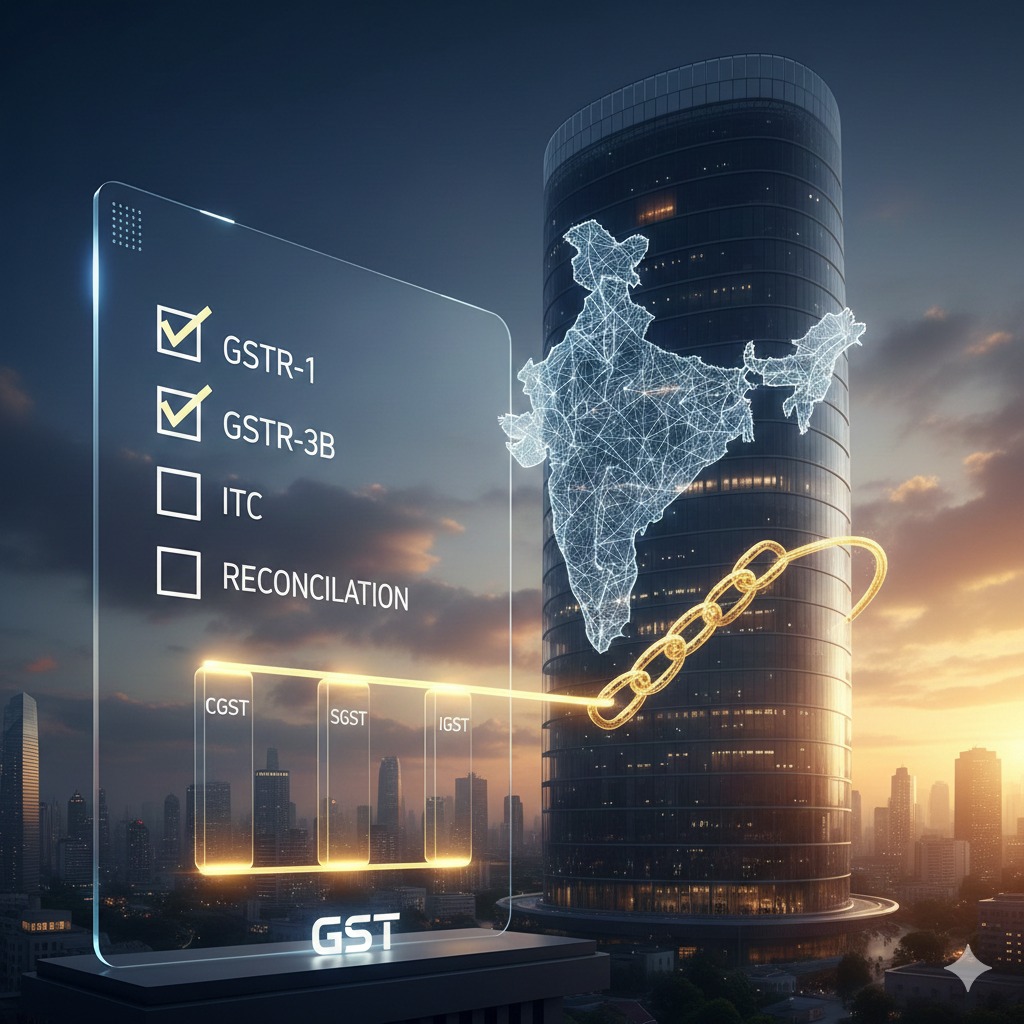
- CGST (Central GST): Collected by the Central Government on intra-state supplies
- SGST (State GST): Collected by the State Government on intra-state supplies
- IGST (Integrated GST): Collected by the Central Government on inter-state supplies
- UTGST: Applicable for Union Territories
Understanding the correct classification is crucial, as errors here often lead to notices and mismatches.
Who Needs to Register Under GST?
GST registration is mandatory if:
- Aggregate turnover exceeds ₹40 lakh for goods or ₹20 lakh for services (lower limits apply in special category states)
- You are making inter-state supplies
- You are an e-commerce seller or operator
- You are liable under reverse charge
- You are a casual or non-resident taxable person
Even businesses below the threshold often opt for voluntary registration to claim input tax credit and deal with GST-registered clients.
Input Tax Credit (ITC): The Backbone of GST
Input Tax Credit allows businesses to set off GST paid on purchases against GST collected on sales. While the concept is simple, compliance is strict.
Key points to remember:
- ITC can be claimed only if the supplier has filed returns
- Invoice details must match with GSTR-2B
- Payment to the supplier must be made within 180 days
- ITC on blocked items like personal expenses, motor vehicles (with exceptions), and certain services is not allowed
Regular reconciliation of books with GSTR-2B is no longer optional; it is essential.
GST Returns: What Businesses Must File
Most regular taxpayers are required to file:
- GSTR-1: Details of outward supplies (monthly or quarterly)
- GSTR-3B: Summary return with tax payment (monthly)
Other returns may apply depending on the nature of business, such as GSTR-9 (annual return), GSTR-9C (reconciliation statement), or returns for composition dealers.
Late filing attracts interest and late fees, and continuous default may result in suspension of GST registration.
Common GST Mistakes to Avoid
From practical experience, these are the most frequent issues seen in businesses:
- Claiming ITC without matching GSTR-2B
- Incorrect classification of goods or services
- Wrong GST rate application
- Delay in return filing
- Ignoring notices from the GST portal
- Poor coordination between accounting data and GST returns
Most GST disputes arise not from intent, but from weak processes and lack of periodic review.
GST is Not Just Compliance, It’s a System
GST should not be treated as a once-a-month filing activity. It is deeply connected with:
- Accounting entries
- Vendor selection and verification
- Pricing and margins
- Cash flow planning
- Internal controls and audits
Businesses that align their accounting systems with GST requirements face fewer notices and operate more confidently.
Final Thoughts
GST has matured over the years, but compliance expectations have also increased. With system-driven scrutiny, auto-generated notices, and tighter controls on ITC, businesses need a structured and proactive approach.
A periodic GST health check, proper documentation, and timely filings go a long way in ensuring peace of mind and long-term sustainability.
If GST is managed well, it becomes a tool for transparency and growth rather than a burden.