
Businesses exist for the sole purpose of maximizing profits for their owners. But one of the greatest businessmen of all times, Henry Ford said “A business that makes nothing but money is a poor kind of business”. This is a very serious statement coming for a very successful businessman. So what does it mean? Businesses are engaged in “Value Creation”. So by implication it is clear that Value is not equal to Money.
So the next question would be what is Value?
Value is created by a business when it generates both monetary and non-monetary benefits not only for the owner but also for the society at large. Non-monetary benefits generally denote the goodwill created by the business for engaging in ethical business practices which uplifts the society in which it operates. It is for this reason that we have companies like Microsoft, Tata Group etc. which are valued far in excess of the assets and liabilities in their Balance Sheets. It is these businesses which transcend turbulent times and business cycles and seem to exist forever. On the other hand, one can easily find big names line Enron, Satyam Computers etc. which disappeared in oblivion for engaging in unethical business practices.
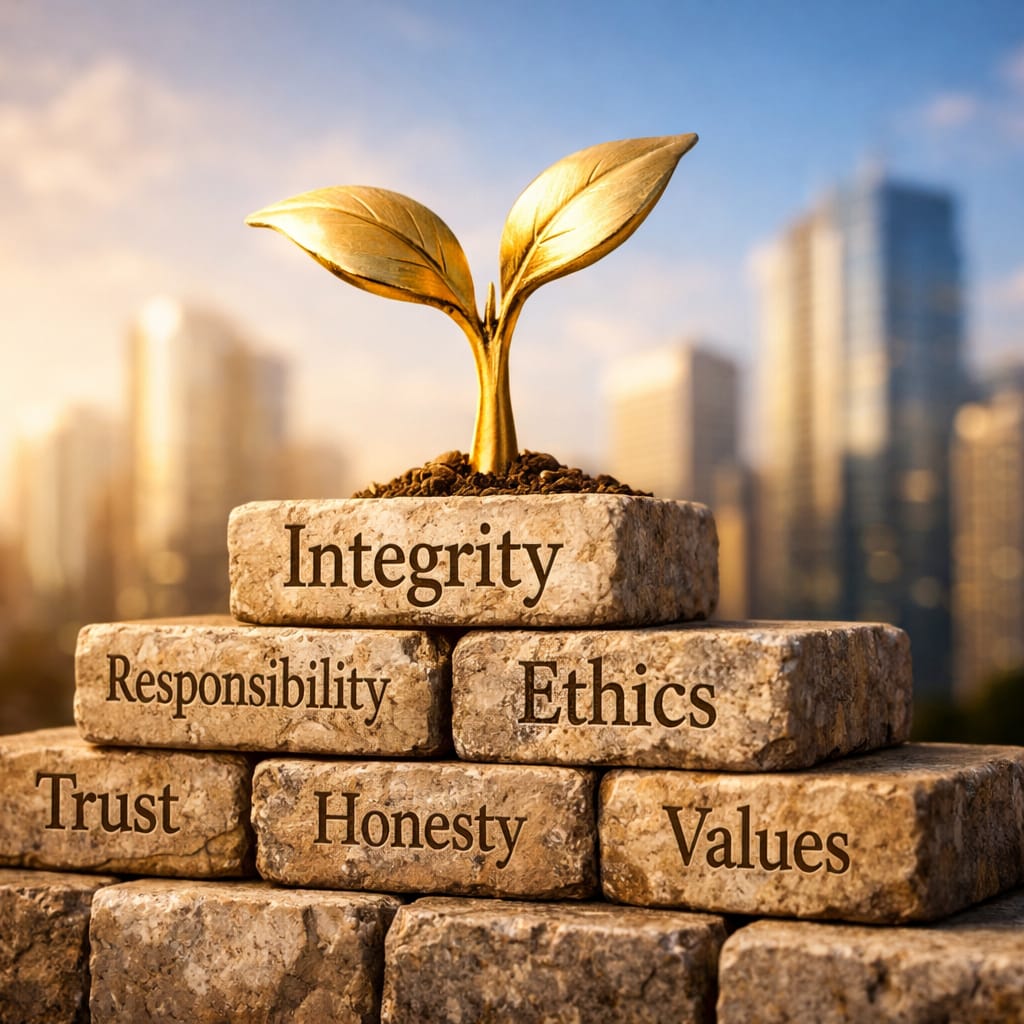
Let us dive deeper into these corporates and understands what values led to their rise or fall. All of us can easily relate to Tata Group which would exist in all homes in India in one form or the other. The Group was founded in 1868 by a Parsee philanthropist Jamesetji Tata. The 5 values of the Group are Integrity, Responsibility, Excellence, Pioneering, and Unity. The companies in the Tata Group follow these values by the letter. A customer would not mind paying a premium for a Tata product as he knows deep down in his heart that a Tata product would live up to his expectation. Similarly, Tata Group companies are actively sought by high caliber professionals even though the compensation packages may not be at par with multi nationals. The Tata Group has existed unaffected by political and social turmoil witnessed by Indian peninsula.
On the other hand, we have companies like Satyam and Enron which were once admired for their speedy successes. These companies suddenly fell from grace and vanished from the corporate world without a trace. The reason, their successes were built upon unethical business practices. E.g. Satyam went down due to promoter’s greed to inflate the share price through dubious accounting practices. Same was the case with Enron. The shareholders lost $74 billion leading up to its bankruptcy, and its employees lost their jobs and billions in pension benefits. So if mighty corporate giants like Satyam and Enron can bite the dust, how could small businesses escape the wrath of the stakeholders if they resort to unethical business practices?
Going by the above examples, it is imperative for a businessman to understand the subject of Ethics in its entirety.
Ethics are moral principles that govern a person’s behavior. They are also known as moral code, morals, morality, moral stand, moral principles, moral values, rights and wrongs, principles, ideals, ethos, rules of conduct, standards (of behavior), virtues, dictates of conscience. Ethics originated with the advent of humanity. All kitalbullah teach ethics to humanity. Anbiya (SA), rosol (SA)) and awliya-ullah (AS) are the teachers of ethics Other than religion, ethics originate from:
- Legal framework of a country
- Social-economic environment
- Family upbringing
Ethics act as a self-governing system to keep human self-interest and the good of society at equilibrium. Without ethics, peace and social justice could not exist. Socio economic progress would not have been possible without ethics
An ethical issue arises when a problem has various solutions to choose from and one has to choose the alternative which is not at odds with the interests of any of the stakeholders.
Some common examples of ethical issues:
- Misrepresenting hours worked
- Employees lying to supervisors
- Management lying to employees, customers, vendors or the public
- Misuse of organizational assets
- Lying on reports/falsifying records
- Stealing/theft
- Withholding needed information from employees, customers, vendors or public
Ethical issues can be broadly classified in the following categories:
- Conflict of Interest
- Communications
- Business Relations
Let us look at some practical examples of each of the categories.
Conflict of Interest
How often we see people who are working for organizations also engaged in some other income generating activities to augment their salaries? We accept it as a normal practice. What we generally don’t see is that an individual may be using his employer’s time and resources to carry on such activities. Worse could be, that the individual could be selling the same products like his employer. Similarly, hiring a relative without disclosing the relation or giving a contract to a related party without proper due-diligence and disclosure are all examples of conflict of interest.
Communication
Do you remember the advertisement of the fairness cream that claimed to change the complexion from dark to light within a matter of days? Can you recall any of your near or dear ones changed his/her complexion as claimed? Probably not. If this claim was correct, immigration authorities would have a huge problem!!
Miscommunication is the most common form of unethical business practice. We see businessmen selling either fake products or duplicates as originals. It is essential that a businessman communicates clearly and truthfully with his customers/suppliers/employees. A business built upon falsehood will not be sustainable even though it may seem to progress fast.
Business Relations
The significance of maintaining good business relations was always a pre-requisite for a successful, thriving business. The COVID pandemic has made business relations an absolute necessity without which businesses cannot survive or thrive. While the businesses move online accelerated by advancement of technology and the pandemic, a business that maintains good relations with its stakeholders is more likely to survive.
So the million dollar question is what makes people behave unethically, given that most of our businessmen have at least a basic understanding of teachings of Al-Quran Al Kareem and Awliyah Kiram AS.
The most common root-causes of unethical behavior are:
- Family Pressure
- Pressure from superiors
- Fear of failure
- Social stigma
- Greed
- Status
- Laziness
I will lose the interest of my readers if I try to explain each of the root-causes! Suffice it to say, we can all relate to some of the pressures we face in our day-to-day lives. Isn’t it the pressure of status which makes us use fake products? Or steal credit from others just to impress our superiors!!
For us mumineen, the issue of ethics is intrinsic to our faith. In fact, our beloved Moula TUS has built our identities on the strong foundation of ethics. In India or around the globe wherever mumineen are, they are trusted as reliable and honest community. We have to always remember that this identity can be double edged sword for us and our community. Would any of us like that any unethical action on our part be attributed to our Moula TUS. If we just keep this realization in front of us, any tendencies to act unethically will be curbed to a great extent.